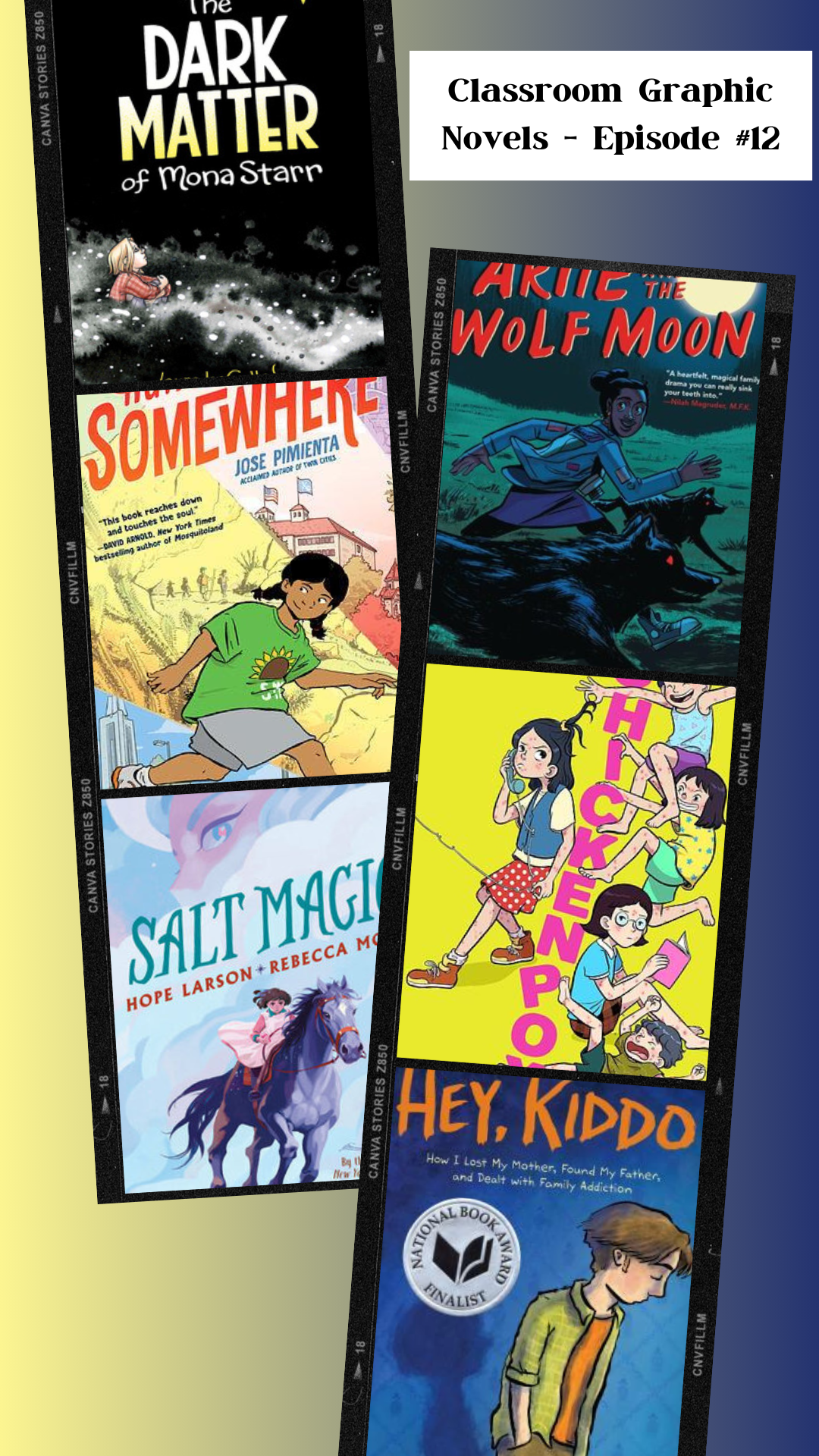

This graphic novel deals with deep, potentially triggering topics. While I do not avoid recommending the book for that reason, I do not recommend the book. The narrative serves as a way for the author to recount a fictionalized version of her own experiences. I will never discount that. I hesitate to recommend this book because unhealthy choices are never pushed back on
nor healthy choices presented. If the author had chosen memoir rather than fiction, I think the genre would have suited this particular story better.
Once again, the Comix kid subscription has picked a strong entry. In this book, a non-binary Mexican American tween has to move with their brother and mother – but not their sister or father – to Kansas for the mom’s new position teaching at a university in Kansas. The split move comes for a couple reasons. One, the mom has a work visa (I believe) while the younger two kids, due to their US birth have US citizenship; the father and

older sister do not. Two, the parents’ marriage has become irreparably strained, in large part due to their father’s unwillingness to support their mom’s career. The main character learns much of this throughout the novel as they also deal with looking more Mexican than their lighter-skinned brother and with struggling more with learning English than he does. I appreciated the honest and vulnerable way that the author told the story and am glad that I could go ahead and put it on my shelves. I know that many of my students will resonate with this story.

This, along with a subsequent two more graphic novels that I will review in the next episode (I’ve got a bit of a backlog) have shown me that while Hope Larson is not the wrong author for me, she’s also not the right one. Although I cannot put my finger on it exactly , something feels missing from each of the narratives. With this one, I should have expected the fantasy element based on the title. When the story opens somewhere int he
rural Western US shortly after WWI with the return of the main character’s brother, I found myself intrigued. Then the magic element got introduced which threw me a little disengaging me from the narrative. Eventually, I got back into the story but not with enough time for the emotional moments to have the weight that they should have.
I enjoyed the story of this one significantly more than Salt Magic which I read immediately prior. I did not care as much for the art style, particularly around facial features and the fact that the entire color palette was extremely dark, but the story more than made up for it. The main character discovers one night that not only are werewolves real but that her mom is one and later that she also has the ability to

transform. Through the paranormal trope of werewolves and vampires the author explores deep topics through fact such as her mom turning her back on her werewolf family after the death of her husband – not a werewolf – at the hands of vampires. I thought tha the author did a fairly good job with the narrative which I will put on the list to add to my classroom library.

This was a fun, full graphic novel from Lai. Although I have not read some of her other works, quick flip throughs show me that those take the form of prose with a hefty amount of illustrations. This tells the fictional story, based on experiences from Lai’s childhood, of when all five of the kids contracted chickenpox, the main character’s worst nightmare since it meant spending two weeks quarantining with her annoying
younger siblings. Through the experience the main character has to learn how her behavior towards her siblings has affected her relationships not only with them but also with her friends and her parents. She has to come to terms with how her reactions are rooted in petty selfishnesses and childishness and learn some important lessons. I will definitely add this to my classroom library.
The graphic memoir provides a powerful tool for expression, especially those authored and illustrated by the artist themselves. Krosoczka had an incredibly difficult childhood, raised by his grandparents who clearly loved him but had significant flaws of their own. He also had a highly complicated relationship with his mother, a teenager when she gave birth to him, and struggled until the end of her life with addiction.

Krosoczkaclearly took great care with how he wrote this story and put a tremendous amount of himself on the page. I do not know, however, whether I will put this on my classroom shelves because I wonder if my students will have enough maturity to comprehend and to give the story the respect it deserves.