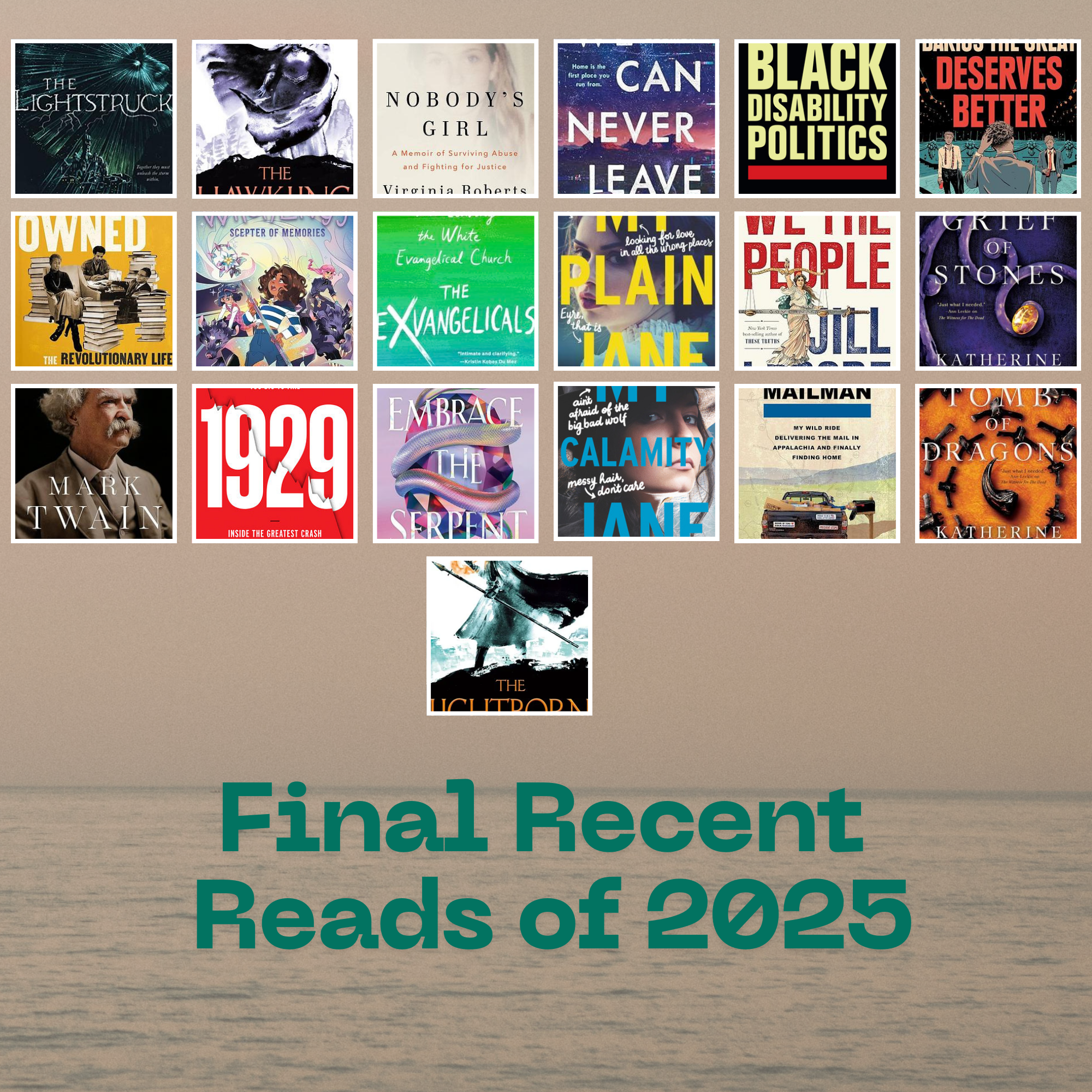
I finally got caught up on my reviews…at the very end of the year. I have quite a few to get through so several of these reviews are on the shorter end. I have plans to improve the timeliness of my reviews next year.
We shall see.

This is one of those cases where the author should not have bothered with the sequel. Overall, the read was fine but stepped way back from the compelling narrative of the original.

I really enjoyed these two sequel mystery fantasy hybrids. Unlike the first book in the spinoff, these mysteries were contained and well-connected. I also appreciated how she

developed the main character. I will definitely pick up more from Addison in the future.
Ortega has ratcheted up the stakes significantly in this installment. I love how she continues to develop all of the witchlings and expand the world in a highly believable way. I hope that I will not have to wait long to read book five.


Grant told a fascinating story about his short time working for the postal service in his rural hometown during the pandemic. While the memoir focuses on a concentrated, fairly short amount of time, Grant weaves in other aspects of his personal history to create a compelling, thought-provoking narrative. I would definitely read from him again.
I highly considered DNF’ing this book early on in the read, persisting only due to the short length and the fact that I had a review copy. I looked forward to this book after reading their middle grade A Flicker in the Dark which captivated my attention and showcased unique character interplay and growth. Not only did this book have none of that but it also had far too many characters and a world that made absolutely no sense. On top of that, Edgmon left the readers with an incredibly inadequate resolution.


I enjoyed this series but not enough to go purchase special editions. Alas, I purchased them far before continuing in the series. Unlike the first book which was filled with world building and

character establishment, these two dove into the plot which, especially in book three, moved quite quickly. I also appreciated, due to my own delay, being able to read the books back to back.

I wish I had written this review closer to reading the novel because I made the mistake of reading the sequel to her Mara’s debut duology before writing this review. That means that the much weaker (in my opinion) earlier work overshadows my memories of this work. I remember being impressed with how much Mara has improved her writing. I will continue to read what she publishes in the future.
I really enjoyed Sorkin’s chronicling of the infamous stock market crash and the surrounding milieu up until the over-long conclusion. He easily could have ended the narrative at least 50 pages sooner, especially with the titular focus.


This is a beautiful tribute to sand study of a handful of influential Black-owned bookstores. Adams highlights the important role they have played and emphasizes the vital need for these stores going into the future. This is well worth the read.
Whatever magic infused the debut, first book, in this duology seems to have vanished in the sequel conclusion. Part of the problem stems from the fact that around two years separated my readings of the two books. The larger part comes from the fact that this plot made little sense and felt noticeably different than its predecessor. Even though I rated the book lower than four stars, I will keep the special edition prior to reading. (Note to self: stop doing that!)


Chernow, once again, does a magnificent job profiling a prominent figure in American history. The book, obviously, is quite long but Chernow’s prose flows well and engages a wide range of readers. Did I need to know about Twain’s strange obsession with young girls? No. However, Chernow handles this topic with care not making assumptions either way while also not glossing over a potentially tragic flaw.

I continue to enjoy the writing of the Lady Janies and their absurdist takes on various literary and historical figures. While I did not enjoy My Calamity Jane as much as the others, I particularly

enjoyed the take on Jane Eyre with the friendship of both Jane and her “creator” Charlotte Bronte. On to the rest of the “Mary” series!
I surprised myself with how much I enjoyed this sequel in what is regarded by many as the premier example of flintlock fantasy. I typically do not prefer/enjoy battle scenes so to enjoy a book that’s an entire campaign? Surprising indeed. I will finish the series soon.


Reading this memoir after the tragic self-exit of the author makes the text even more powerful. This is an incredibly tough but highly valuable read.
Having studied this topic quite extensively in my history degrees, I still appreciated Lepore’s adept handling of the topic in which she creates a compact (yes, I know the length but consider the source material: 250+ years) history of the United States through the lens of its Constitution as well as the attempts – both successful and unsuccessful – to amend it.


(I do not rate memoirs.)
This book hit different reading it now as opposed to if I had read it when I first obtained a copy a couple years ago through libro.fm’s alc (advanced listener copy) program. McCammon discusses quite a lot of things that resonate and even though I have processed some things differently. I still highly recommend this book.
Shalck wrote an excellent epigraph on the intersection of black disability politics and activism. I kept in mind throughout my read, the note she makes explicit at the beginning, that she did not write this for people like me but still invited us to listen and learn which I definitely did.
