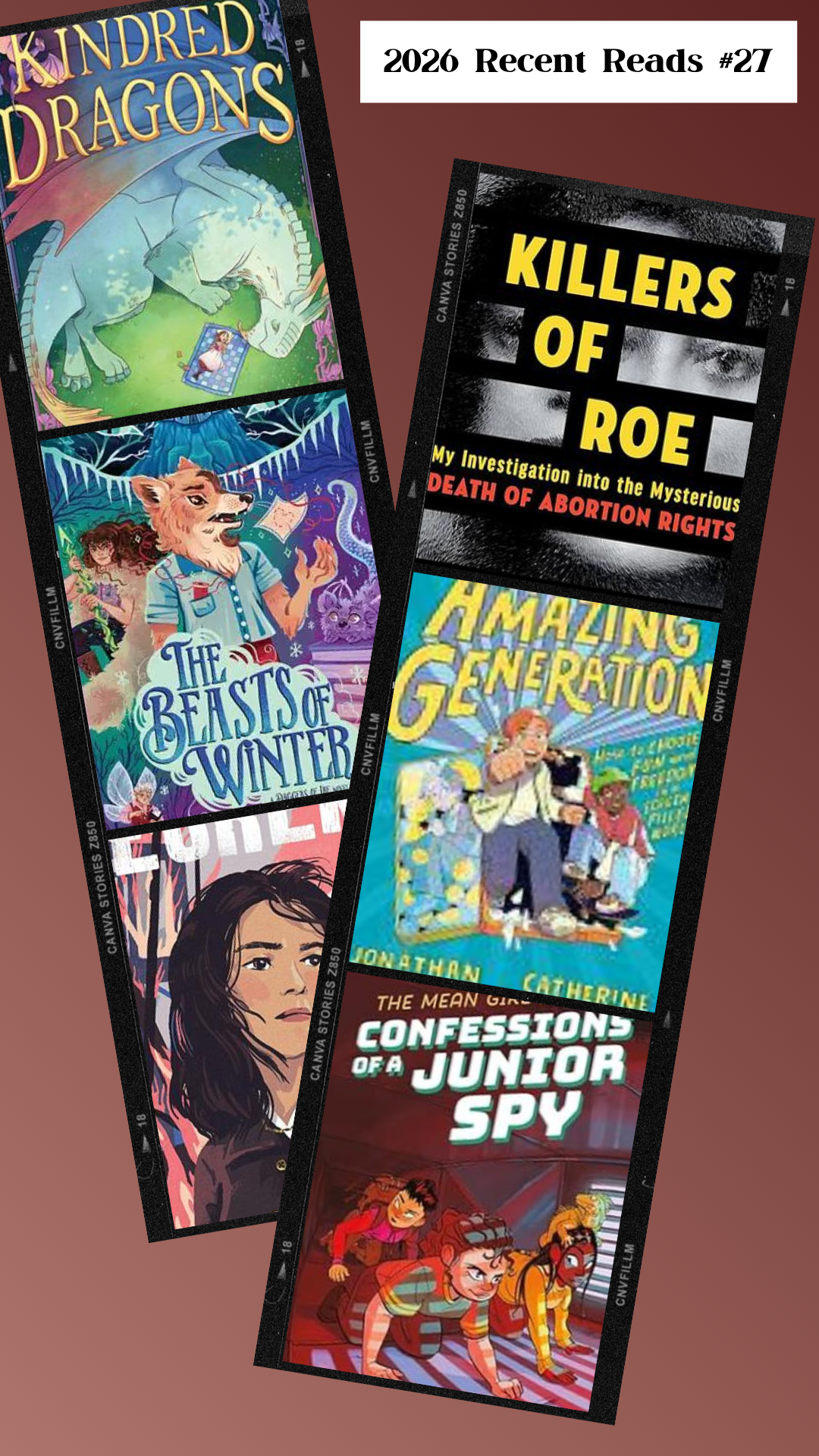

This book is absolutely adorable. This graphic novel takes place in late 1800s England with one primary difference, dragons exist and bond with humans. There’s a catch with that bond though. Only women of certain families have this ability. The main character, although being the granddaughter of one, does not have this ability since her grandmother adopted her children as she was “supposed” to do to avoid having this power concentrated
among a specific few. The main character does not give up home even though she struggles when her best friend gains a kindred and seemingly abandons the main character for others with kindreds. The main character also starts to interact with a seemingly rogue dragon that the townspeople fear; although part of that reality, most people only tolerate dragons. Mensinga uses this fantastical setting to explore how, despite safeguards, prejudice can still develop and how it expresses itself. I highly recommend this graphic novel.
I am so glad that I read the first book in this companion series. Although technically one can read this without having read The Daggers of Ire where the main character, Fetch the fox, first appears, that would significantly diminish the reading experience. In this companion sequel Cervantes expands on the world by setting the story entirely in one part of the magic revealed in book one. Cervantes, though Fetch, explores how grief, remorse,

and self-imposed guilt deeply affect a person, making Fetch a highly developed character, something, unfortunately, not seen in many middle grade works. I, thus, continue to highly recommend Cervantes’ books.

This book shines a light on a tragic and reprehensible piece of American history, the rapid – and often violent – expulsion of people of Chinese descent from people in towns like Eureka in Northern California in the late 1800s. The narrative lays bare – but does not explore in depth – the awful racism that Chinese Americans faced, racism codified in law with the 1882 Chinese Exclusion Act. The lack of depth stunts the impact this narrative could have had. The verse flowed well,
poignantly. While novels in verse tend to be picked up more readily by middle grade and other reluctant readers, not every story is best served by this style writing. Chang wrote well but I wish that the text could have taken another form to have a greater impact.
In the current political climate (and world) this is not a “happy” book. It also does not end hopefully; autopsies rarely do. Rather, this book chronicles the various actors, events, and legislation that led to the infamous, historic Dobbs decision. Littlefield does not spare scrutiny from any actor whether those fighting to protect abortion access or those fighting for its stringent restriction with a heavy finger of blame directed towards

complacency of the pro-choice movement after Roe and even after Casey. This book is both enlightening and sobering, well worth the read, especially if after you know better, you do better to paraphrase the incomparable Maya Angelou.

This book, unfortunately, met my expectations. I do not generally read self-help type books so ojne intended for middle schoolers by the author of the popular Anxious Generation (a book with plenty of faults of its own) had little chance of success for me. I did not expect much and I
did not get much. I also struggle to envision many middle schools who would persist after opening the book to discover that the cartoon cover did not match the contents.
Although I did not intend to read three books by Rosaria Munda within the same month – same week actually – I had success with all three of the reads. I actually enjoyed this sequel more than the first book in the series. (I did not read that one this month.) Munda kept the plot tight and moving while not overloading the story with too many elements. I think middle schoolers will enjoy this read although I know that Munda could have put more depth into the narrative overall.
