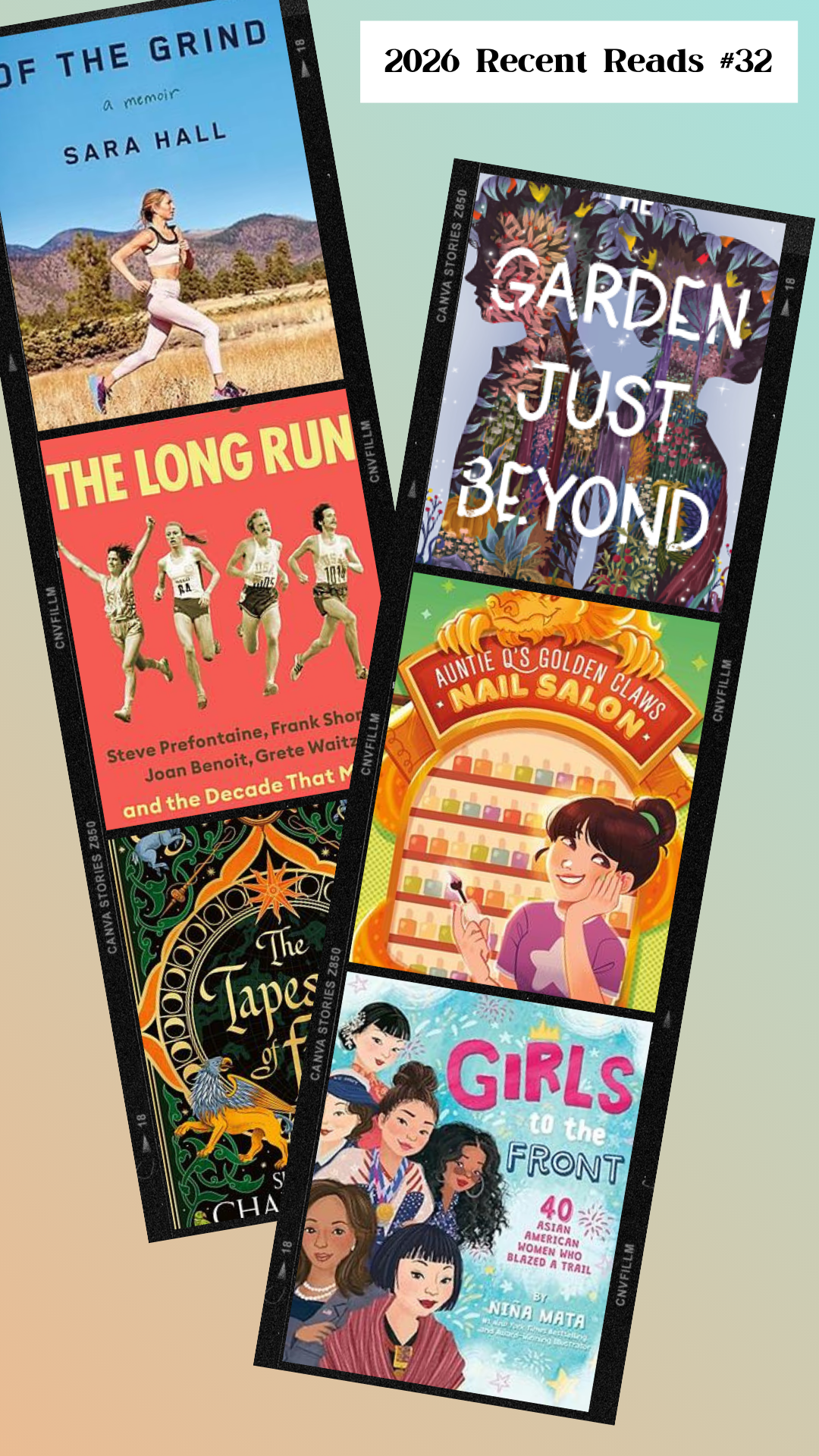

I really appreciated this memoir from Sara Hall. She is a runner that I have followed fairly closely over the past few years as she became more of a name in the women’s marathoning sphere, something I have found particularly fascinating, being a marathoner myself. Both Sara and Kiera D’Amato have been particular favorites of mine due to the fact that we are quite close in age so I have enjoyed seeing their successes.
While Sara does not go into depth about a lot of her story in this relatively short memoir, she does craft it with an air of vulnerability and care. I noticed this especially when she talked about the mental health struggles of one of her daughters. She took great care to protect that daughter by not naming her specifically as she described these struggles and how that affected both the daughter and Sara as the events unfolded, events that did not rise to public attention (as that should be.
I definitely recommend this book.
I intentionally chose to read this book in the lead up to a half marathon. I love running and I love history so, thankfully, this book appealed to both of those aspects and did it fairly well. One can tell that Dugard has personal interest in the topic from his own experience as that passion shines through in the narrative.
While not much of what Dugard discussed in the book comes as a surprise to me, I still thoroughly enjoyed reading about it and seeing how running has developed to become the sport it is today. (I will admit to bias regarding Joan Benoit Samuelson and female marathoning.) I think that others who may not have the personal connection to the sport would still find this text engaging and entertaining so I definitely recommend it.


There’s just something about Chakraborty’s writing that keeps me hooked and coming back for more. I sincerely hope that we do not have to wait three more years before getting the next book because that ending!
Even though it had been several years since I read the first book in the series, I immediately fell right back where we left off with Amina grappling with the significant changes that have happened due to the events of the first book.
I appreciate how Chakraborty opened the book with rapid fire events that both immediately engage the reader and help explain how this story can wrap up in a trilogy rather than a much longer series.
I also appreciate how Chakraborty continues to flesh out Amina’s character making her an utterly realistic person (despite the magical qualities) who continues to make what turn out to be devastating mistakes in the effort to keep everybody safe.
I eagerly anticipate the next book in the series and whatever else Chakraborty writes.
I know that you’re not supposed to judge a book by its cover but let’s be honest. We all do. This time doing so led me astray.
When I started my read of this book, it had been quite a while since I had read the synopsis. I did not bother going back and reading the synopsis before I started the read. That may or may not have been a bad idea.
I expected much more of a contemporary novel than the narrative that I got. This narrative delves into some magical realism along with a bit of the absurd which I did not expect at all. Thus being thrown off-kilter, I struggled to reengage with the main character and the overall plot of the story. I ended up feeling at arms length from the characters for the entire narrative, which while fine, did not wow me in any way resulting in a fairly average read, not one that I would recommend for or against reading.


Hoang did a fantastic job with this narrative, really capturing the authentic voice of the main character who is “forced” to spend the summer with her aunt working in her aunt’s nail salon to pay back her parents for a mistake (that we learn more about as the narrative unfolds.) I immediately engaged with the main character as she struggled to find her place and figure out how to make up for her mistake. I could not, however give this book more than four stars because Hoang does bring up a couple issues that do not receive adequate attention or explanation such as her aunt’s hoarding tendencies or the actual reason why her aunt and her mother are estranged. (The narrative provides a small explanation but that explanation does not really make sense or provide adequate resolution.) Overall, I think that this book is a really strong read and one that many middle school readers will be able to engage with and enjoy.
This is a fine compendium of very short biographies of influential Asian American women. Mata describes each woman profiled well.
I will admit that this sort of book is not my favorite because of the lack of depth, something inherent in such a design. I prefer to learn more about a topic rather than get just an overview. Middle grade readers, however, depending on their age, need shorter chapters to hold their attention and might benefit from using this book as a resource.
